Exercise and COPD: How the Right Workout Protocol Improves Lung Function and Quality of Life
Exercise and COPD: How the Right Workout Protocol Improves Lung Function and Quality of Life
Medical Disclaimer: This article is for informational purposes only and does not constitute medical advice. Always consult with a qualified healthcare provider before making changes to your medications, supplements, or health regimen.
For the 16 million Americans diagnosed with chronic obstructive pulmonary disease (COPD), the idea of exercise can feel counterintuitive — even frightening. When every breath is a challenge, why would you deliberately make your lungs work harder? The answer, backed by decades of research, is that carefully structured physical activity is one of the most powerful tools available for managing COPD, improving lung function markers, and dramatically enhancing quality of life.
Why Exercise Matters in COPD
COPD is characterized by persistent airflow limitation caused by airway inflammation, mucus hypersecretion, and destruction of lung tissue (emphysema). The disease creates a vicious cycle: breathlessness leads to inactivity, inactivity leads to muscle deconditioning, and deconditioning makes every physical task feel more exhausting — worsening breathlessness further.
Exercise breaks this cycle. According to the [Global Initiative for Chronic Obstructive Lung Disease (GOLD)](https://goldcopd.org/), pulmonary rehabilitation — which centers on supervised exercise — is the single most effective non-pharmacological intervention for COPD. Studies published in the [Cochrane Database of Systematic Reviews](https://www.cochranelibrary.com/) confirm that exercise training reduces dyspnea (breathlessness), improves exercise capacity, and lowers rates of COPD-related hospitalizations.
Key Lab and Functional Markers to Track
Before starting an exercise program, your healthcare provider will likely assess several markers:
- FEV1 (Forced Expiratory Volume in 1 second): The gold-standard spirometry measure of airflow obstruction. GOLD staging uses FEV1 % predicted to classify COPD severity (GOLD 1–4).
- FVC (Forced Vital Capacity): Total air exhaled forcefully; the FEV1/FVC ratio below 0.70 confirms obstruction.
- SpO2 (Oxygen Saturation): Resting and exercise SpO2 guide whether supplemental oxygen is needed during activity.
- 6-Minute Walk Test (6MWT): A functional measure of exercise capacity strongly correlated with COPD prognosis.
- BODE Index: Combines BMI, airflow obstruction, dyspnea, and exercise capacity to predict mortality risk.
- CRP and IL-6: Systemic inflammatory markers often elevated in COPD; exercise can reduce these over time.
- Modalities: Walking, stationary cycling, treadmill, or aquatic exercise
- Intensity: Moderate intensity (60–80% of peak work rate) produces the greatest physiological gains
- Duration: 20–60 minutes per session
- Frequency: At least 3–5 days per week
- Interval training option: For patients who cannot sustain continuous moderate exercise, high-intensity interval training (HIIT) with short work-rest cycles achieves similar benefits with less dyspnea during sessions
- Target muscles: Lower extremities (quads, hamstrings, glutes), upper body, and respiratory muscles
- Protocol: 2–3 sets of 8–12 repetitions at 60–70% of one-repetition maximum
- Frequency: 2–3 days per week
- Benefit: Improves muscle mass, reduces fatigue, and enhances functional independence
- Protocol: 30 breaths at 30–50% of maximal inspiratory pressure, twice daily
- Evidence: A [meta-analysis in Respiratory Medicine](https://pubmed.ncbi.nlm.nih.gov/) found IMT significantly improved inspiratory muscle strength and exercise capacity in COPD patients
- Gentle stretching of chest, shoulder, and thoracic muscles improves posture and breathing mechanics
- Balance training reduces fall risk, which is elevated in COPD due to muscle weakness and medication side effects
- Monitor SpO2: Use a pulse oximeter during exercise; stop if SpO2 drops below 88% and consult your provider about supplemental oxygen
- Use bronchodilators strategically: Taking your short-acting bronchodilator 15–30 minutes before exercise can reduce exercise-induced bronchospasm
- Pace yourself: Use the Borg Dyspnea Scale (target 3–4 out of 10) to gauge exertion
- Pursed-lip breathing: Exhale slowly through pursed lips during exertion to reduce air trapping and improve gas exchange
- Avoid extreme temperatures: Cold, dry air and high humidity can trigger bronchospasm; exercise indoors when conditions are unfavorable
- Recognize warning signs: Stop exercise and seek help if you experience chest pain, severe breathlessness beyond your baseline, dizziness, or cyanosis (bluish lips or fingertips)
- 2–4 weeks: Reduced perception of breathlessness during daily activities
- 6–8 weeks: Improved 6-minute walk distance and exercise tolerance
- 3 months: Measurable reductions in CRP and systemic inflammation; improved muscle strength
- 6–12 months: Reduced COPD exacerbation frequency and hospitalizations; improved health-related quality of life scores (CAT, mMRC)
- Supervised exercise training (aerobic + resistance)
- Breathing technique education
- Nutritional counseling
- Psychosocial support
- Self-management education
Regular monitoring of these markers helps you and your care team gauge how well your exercise program is working.
The Evidence-Based Exercise Prescription for COPD
Research from the [American Thoracic Society](https://www.thoracic.org/) and [European Respiratory Society](https://www.ersnet.org/) supports a multicomponent approach:
Aerobic (Endurance) Training
Aerobic exercise is the cornerstone of COPD management:
A landmark [New England Journal of Medicine](https://www.nejm.org/) study found that pulmonary rehabilitation reduced hospital readmissions by 40% in patients with acute COPD exacerbations.
Resistance (Strength) Training
COPD causes significant peripheral muscle wasting, particularly in the quadriceps. Strength training addresses this directly:
Respiratory Muscle Training
Inspiratory muscle training (IMT) using a threshold device strengthens the diaphragm and accessory breathing muscles:
Flexibility and Balance
Practical Safety Guidelines
Exercising with COPD requires careful attention to safety:
What to Expect: Timeline of Benefits
Consistent exercise produces measurable improvements across multiple timeframes:
A [Cochrane review of 65 trials](https://www.cochranelibrary.com/) involving over 3,800 COPD patients confirmed that pulmonary rehabilitation consistently improves exercise capacity and health-related quality of life compared to usual care.
Pulmonary Rehabilitation: The Gold Standard
For moderate-to-severe COPD (GOLD stages 2–4), formal pulmonary rehabilitation programs offer the most comprehensive benefit. These programs typically include:
Medicare and most insurance plans cover pulmonary rehabilitation for qualifying COPD patients. Ask your pulmonologist for a referral.
Home-Based Exercise: Maintaining Gains Long-Term
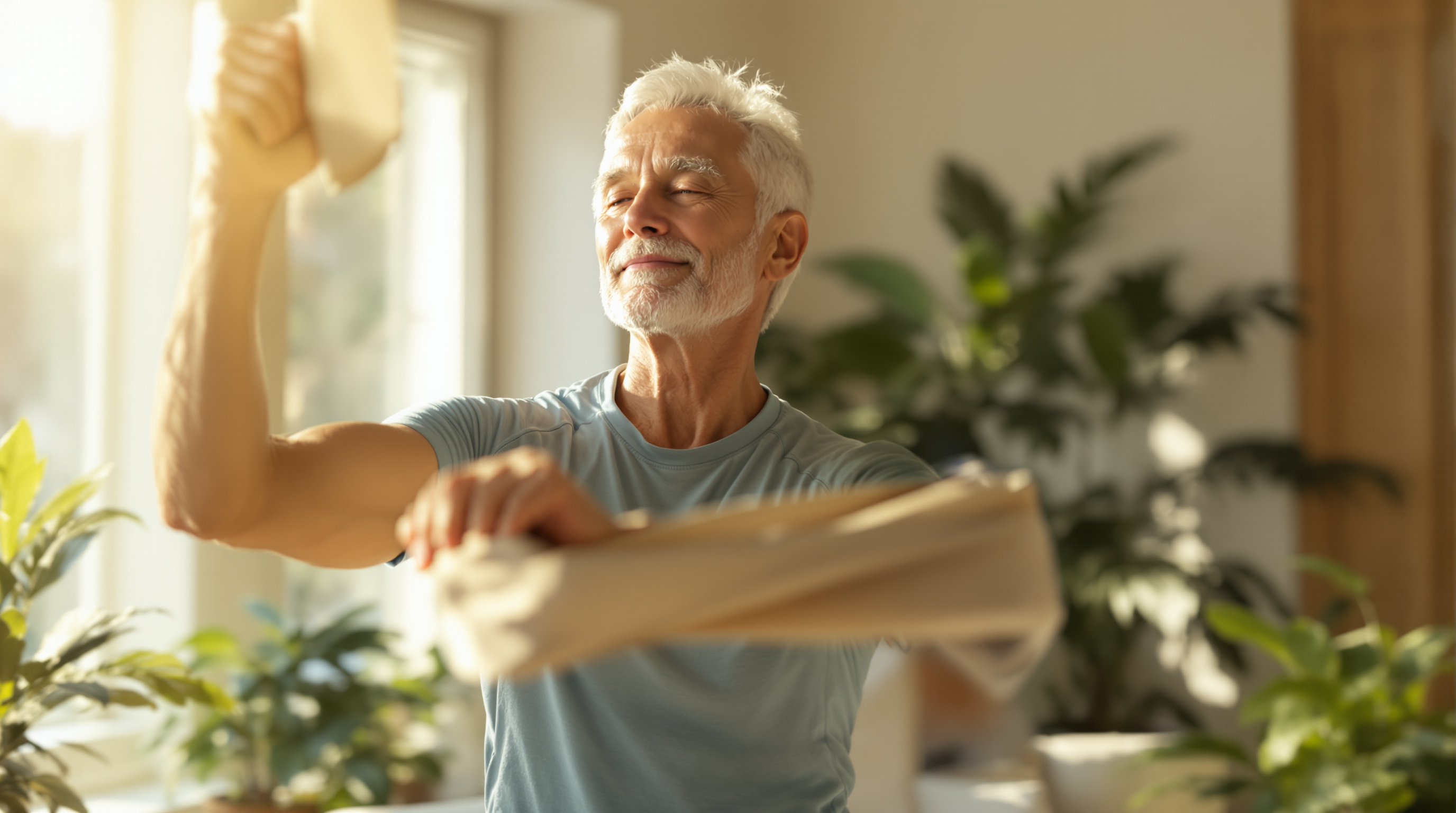
Research shows that benefits from pulmonary rehabilitation decline within 12 months without ongoing activity. Home-based maintenance programs — including walking programs, resistance bands, and telehealth-supervised exercise — help sustain gains. Wearable devices that track steps, heart rate, and SpO2 can provide real-time feedback and motivation.
---
Take Control of Your Health Data
Ready to cross-reference your medications, supplements, and lab results in one place? [Health Intelligence Analyzer](/) helps you identify potential interactions, flag abnormal lab values, and optimize your health regimen with AI-powered insights. Start your free analysis today.